Stained Glass Restoration That Protects History
A stained-glass window can look intact from across the room while its structure is quietly failing. Hairline cracks, bowed lead lines, loose panels, fading paint, and failing perimeter putty are not merely cosmetic concerns. In a historic home, stained glass restoration protects an original architectural feature before a small weakness becomes lost glass, water damage, or a much larger repair.
For homes built between 1870 and 1940, decorative glass was often designed as part of the house itself. A transom at the entry, a colored landing window, or a beveled panel beside the front door was made for that opening, that trim profile, and that particular light. Replacing it with modern decorative glass may fill the opening, but it rarely preserves the workmanship or character that made the home distinctive.
What Stained Glass Restoration Actually Preserves
True restoration is not a quick patch with clear adhesive or a new insulated glass unit behind the original panel. It is a careful process of preserving as much historic material as possible while returning the window to structural strength and weather resistance.
That begins with the glass. Older stained and textured glass has variation that cannot be duplicated exactly by off-the-shelf materials. Its color may shift slightly across a single piece. Its surface may be rippled, seeded, beveled, or hand-rolled. These qualities are part of its value, especially when sunlight moves through the window during the day.
The lead came is equally important. These narrow channels hold the glass pieces together and establish the design. Over decades, lead naturally weakens and stretches. A panel may begin to bow, individual joints may crack, and the glass can rattle within its channels. Proper work addresses the assembly as a system rather than treating each visible crack as an isolated problem.
Finally, there is the setting. Stained glass is often installed in a wood sash, an exterior door, or a transom frame that has its own problems: failed paint, deteriorated putty, moisture intrusion, or loose stops. Restoring the panel without correcting the surrounding wood leaves the work vulnerable to the same conditions that caused the damage.
Signs Your Historic Glass Needs Attention
A broken piece is the obvious warning sign, but it is not the only one. Homeowners should look closely for movement in the panel, sagging or bowed sections, white residue around lead joints, gaps at the perimeter, water staining on nearby wood, and pieces that appear loose or out of alignment.
Cracked glass also deserves a closer look than a surface repair can provide. A crack may be stable in an interior panel that is well supported and protected. In an exterior-facing window or operable sash, however, movement, vibration, heat, and moisture can cause the crack to spread. The right decision depends on the location, the significance of the piece, and the condition of the panel as a whole.
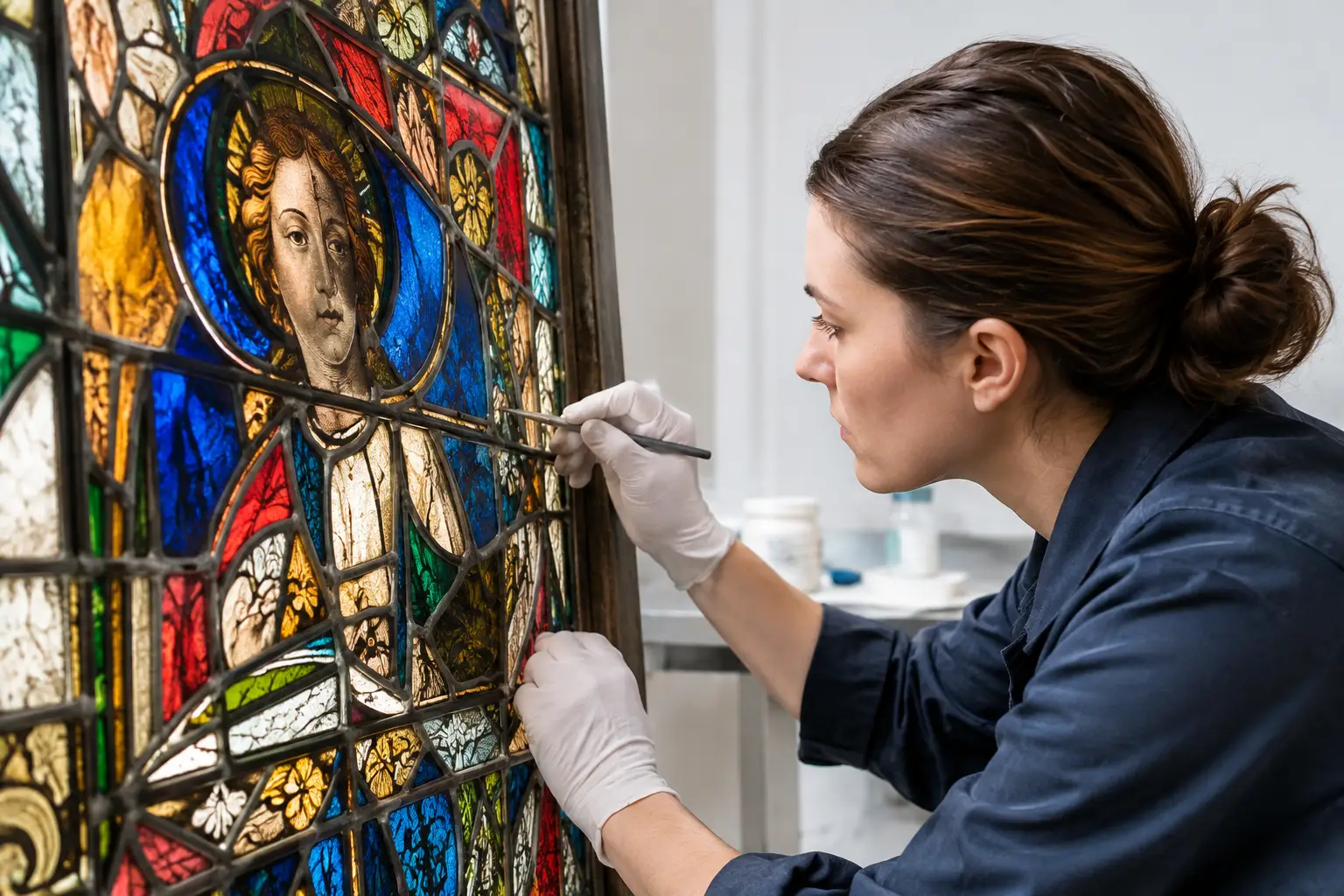
Painted details require special care. Faces, floral accents, borders, and shading may have been kiln-fired onto the glass decades ago. Abrasive cleaning, harsh chemicals, and amateur repairs can permanently damage that surface. If the window has painted decoration, treat cleaning and repair as preservation work, not ordinary household maintenance.
When Repair Is Enough and When Releading Is Necessary
Not every stained-glass panel needs to be completely dismantled. A sound panel with one damaged piece may be repaired locally, particularly when the lead came remains firm and the panel is flat. This approach keeps more original material in place and may be the most cost-effective option.
But there are limits. If the panel is bowed, the lead is brittle, joints are failing across the design, or several pieces are loose, spot repairs only postpone the real work. In those cases, releading may be necessary. The panel is carefully documented, taken apart, cleaned, rebuilt with appropriately sized lead came, soldered at the joints, cemented for rigidity and weather resistance, and reset in its frame.
Releading is more involved, but it is not a failure of preservation. It is often what allows original glass to remain in service for generations. The goal is to retain the historic glass wherever possible while renewing the structural material that has reached the end of its useful life.
A good restoration plan also recognizes the value of original imperfections. Small bubbles, subtle color variation, and the irregular lines of old glass are evidence of age and craftsmanship. They should not be erased in pursuit of a factory-perfect appearance.
The Frame Matters as Much as the Panel
Historic stained glass depends on a stable opening. When wood sashes, door rails, muntins, or trim have deteriorated, the panel can flex or take on moisture. That movement stresses the lead and glass. A restored panel placed back into an unstable frame is being asked to fail again.
This is why stained glass restoration often overlaps with wood window restoration. Rotten sections should be repaired with compatible wood. Loose joinery needs to be stabilized. Old glazing and paint should be addressed so water is directed away from vulnerable edges. Where a panel is set into an exterior sash, careful reglazing helps secure the glass and protect the wood at the same time.
For North Texas homes, heat matters as well. Strong sun exposure can make a poorly supported panel expand and contract repeatedly. A well-fitted protective storm window may reduce weather exposure and help guard against windblown debris, but its design must allow the historic assembly to breathe. A sealed, unventilated layer can trap heat and moisture where neither belongs.
Why Replacement Is Usually the Wrong Starting Point
Replacement companies often treat stained glass as an obstacle to a new window package. They may offer to remove the panel, place it between panes of insulated glass, or substitute a modern decorative insert. Those options can be appropriate in limited circumstances, but they should not be the automatic answer for a historic home.
Encapsulating an original panel between sealed glass units changes how it looks. Reflections increase, texture can become harder to see, and the glass no longer reads with the same depth. It can also create future access problems if the insulated unit fails. Reproducing the design in new glass may preserve a visual idea, but it does not preserve the original work.
There is a practical side to restoration, too. A properly repaired panel, stable wood sash, sound perimeter glazing, and a well-made storm window can significantly improve comfort without removing the historic fabric. Full replacement is not your only option, and for homes in conservation or historic districts, it may create avoidable approval issues.
What a Careful Restoration Process Looks Like
The process should begin with an assessment of both the panel and its surrounding frame. A craftsman needs to understand what is original, what has been repaired before, where moisture is entering, and whether the panel is structurally stable enough to remain in place during work.
Before disassembly, the design should be photographed and documented. Every piece has a location. If glass must be removed, it is handled, labeled, and protected so the original pattern can be accurately rebuilt. Replacement glass should be selected for the closest available match in color, texture, thickness, and transparency, not simply for convenience.
After the panel is restored, it must be installed without forcing it into an out-of-square historic opening. Old houses move. Their frames are rarely perfectly uniform, and that is not an excuse for careless fitting. It is a reason for patient, custom work.
Protecting Restored Glass After the Work Is Done
Once the panel is stable, simple habits help preserve it. Do not press on lead lines when cleaning. Use a soft cloth and gentle methods rather than abrasives or ammonia-heavy products. Keep gutters, flashing, and exterior paint in good condition so water does not repeatedly reach the sash or frame.
If a door or window begins sticking, rattling, or admitting water, address it early. The glass may not be the source of the problem, but it will often suffer the consequences. Seasonal inspections are especially worthwhile for entry doors, exterior transoms, and windows exposed to strong afternoon sun.
Historic stained glass was made to be used and enjoyed, not removed at the first sign of age. With the right repair scope, compatible materials, and attention to the surrounding woodwork, it can remain a working part of the home rather than a fragile artifact. For homes that deserve better than replacement, a careful assessment is the first step toward preserving the craftsmanship and protecting it from the next generation of damage.